Why does a song give you goosebumps?
Why does a song give you a chill with no cold?
- Your heart goes faster and you breathe more.
- Your brain gives dopamine, as it does for food.
- The dopamine comes before the big moment.
The chill is your brain, waiting for the music.
The same text at three levels
This is how it begins at A1, at B1 and at C1. You choose the version you enjoy.
You listen to a song. You like it a lot. Your favourite moment comes.
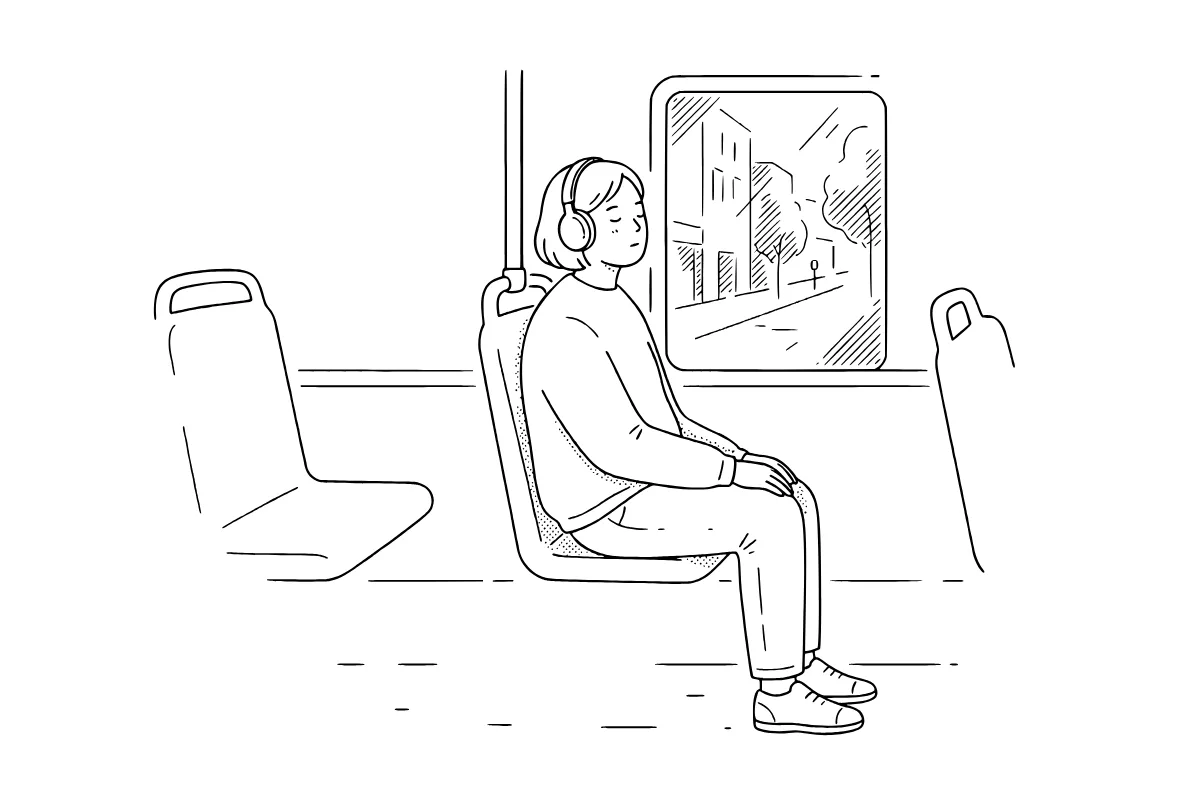
You are on the bus with your headphones on. A song you know by heart is playing. You know that your favourite part comes in a minute.
You are on the bus with your headphones on. A song you know by heart is playing, and you know that your favourite passage comes in a minute.
Words for the text
- chill
- A quick shiver on the skin.
- goosebumps
- Tiny bumps on your skin.
- dopamine
- It makes you feel good.
- reward
- A good thing you get.
- expectation
- What you think will happen.
- surprise
- Something you did not expect.
The opening of the text
Cold without cold
You are on the bus with your headphones on. A song you know by heart is playing. You know that your favourite part comes in a minute.
Then it arrives. The music opens up, and a voice joins in. Something electric runs up your back, to your neck and down your arms.
Nothing around you explains it. It is not cold. Nobody has touched you. There is no danger. Only the air has changed, and it moves against your eardrum.
Sometimes the tiny hairs on your skin stand up, and you get goosebumps. This time they do not mean cold or fear. They come with a strong pleasure.
Scientists call this feeling a musical chill, or a frisson. It lasts only a few seconds. The music that causes it is different for each person.
It is not only music. People have felt it with poems, films, dance and beautiful views. So why does a brain made for survival give a prize for a line of sounds?
In a few words
A song can make you feel a little cold ({shiver}). Your body changes. Your head gives you a good feeling. It comes before the big moment. Not everyone feels it the same.
Sources
- Source: A. J. Blood and R. J. Zatorre, 'Intensely pleasurable responses to music correlate with activity in brain regions implicated in reward and emotion', PNAS, 2001, pmc.ncbi.nlm.nih.gov/articles/PMC58814
- Source: McGill University (The Neuro), press release on the Nature Neuroscience study of V. Salimpoor and others, 12 January 2011, sciencedaily.com/releases/2011/01/110112111117.htm
- Source: L. Harrison and P. Loui, 'Thrills, chills, frissons, and skin orgasms', Frontiers in Psychology, 2014, europepmc.org/article/PMC/PMC4107937
- Source: Wikipedia, 'Frisson', en.wikipedia.org/wiki/Frisson
Levels
More texts in English
- Non-fictionIs there such a thing as the best diet?
Less fat or fewer carbs? A year later: a draw.
- Non-fictionThe internet lives under the sea
Where does your photo go? Under the sea.
- Non-fictionWhy do we yawn, and why are yawns catching?
Why do we yawn, if it is not to get oxygen?
- Non-fictionSleeping with half a brain
How does a bird sleep when it will not land for ten days?
An envelope with three complete texts at your level, as a PDF, free.
Get your free envelope