Sleeping with half a brain
How does a bird sleep when it will not land for ten days?
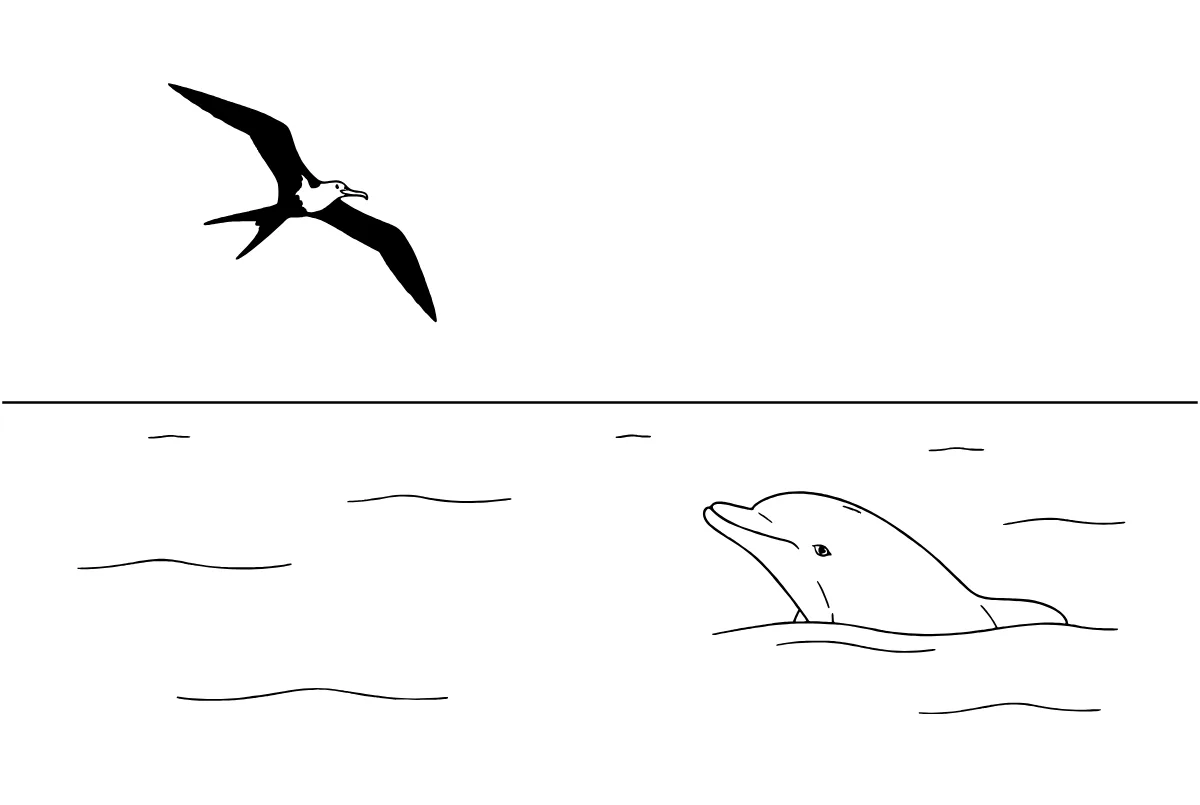
- Dolphins sleep with half of the brain and one eye open.
- In 2016, sensors showed that the frigatebird sleeps in mid-flight, a few seconds at a time.
- In the air it sleeps 41 minutes a day. On land, it sleeps for more than half of the time.
Almost every animal sleeps. Some do it in very surprising ways.
The same text at three levels
This is how it begins at A1, at B1 and at C1. You choose the version you enjoy.
A bird flies for ten days over the sea. It never lands. But it sleeps. It sleeps in the air. It sleeps a few seconds at a time.
A sea bird can fly for ten days over the ocean without ever landing. Yet it sleeps: in mid-air, in moments of a few seconds. A dolphin, for its part, sleeps with half of its brain and one eye open. How is that possible?
A seabird spends up to ten days over the ocean without landing, and yet it sleeps: in mid-flight, in episodes of a few seconds. A dolphin rests with half of its brain and one eye open. Neither has given up sleep, and that stubbornness says a lot about what sleep is worth.
Words for the text
- hemisphere
- Each half of the brain.
- wave
- It goes up and down.
- dream sleep
- Sleep with strong dreams.
- predator
- An animal that hunts.
- frigatebird
- A big black sea bird.
- octopus
- A sea animal with eight arms.
The opening of the text
Sleep is a danger
A sea bird can fly for ten days over the ocean without ever landing. Yet it sleeps: in mid-air, in moments of a few seconds. A dolphin, for its part, sleeps with half of its brain and one eye open. How is that possible?
For an animal, sleep has a price. It does not look for food. It reacts much less to what happens around it. Yet almost all the animals that scientists have studied sleep in one way or another. If they are stopped from sleeping, they catch up on the lost sleep later. We ourselves spend a third of our life asleep.
To look inside an animal's head, scientists put small sensors on it. They record the waves of its brain. When it is awake, the brain makes small, fast waves. In deep sleep, the waves become big and slow.
There is another kind of sleep, called dream sleep. The brain is almost as active as when awake. But the muscles lose all their strength. In people, this is the time of the most vivid dreams.
In a few words
Sleep is a danger. Some birds sleep in the air. A sea animal ({dolphin}) sleeps one side at a time. Horses and giraffes sleep little. A small flying animal sleeps a lot. An animal with eight arms ({octopus}) has two sleeps.
Sources
- Source: Springer Nature: N. C. Rattenborg and others, “Evidence that birds sleep in mid-flight,” Nature Communications 7 (2016), 12468; J. M. Siegel, “Clues to the functions of mammalian sleep,” Nature 437 (2005)
- Source: Elsevier (Cell Press): O. I. Lyamin and others, “Cetacean sleep: an unusual form of mammalian sleep,” Neuroscience and Biobehavioral Reviews 32 (2008); O. I. Lyamin and others, “Fur seals suppress REM sleep for very long periods without subsequent rebound,” Current Biology 28 (2018); S. L. de S. Medeiros and others, “Cyclic alternation of quiet and active sleep states in the octopus,” iScience 24 (2021)
- Source: Frontiers: L. Greening and S. McBride, “A review of equine sleep: implications for equine welfare,” Frontiers in Veterinary Science 9 (2022)
- Source: Giraffe Conservation Foundation, “Do giraffe lie down?” giraffeconservation.org
Levels
More texts in English
- Non-fictionIs there such a thing as the best diet?
Less fat or fewer carbs? A year later: a draw.
- Non-fictionHow do bees make honey?
Bees fly twice around the Earth for one jar of honey.
- Non-fictionWhy does the sea go in and out?
The Moon is more than 225,000 miles away. How does it lift the sea 30 feet in Alaska?
- Non-fictionA day on Venus lasts longer than its year
On Venus, a day lasts longer than a year.
An envelope with three complete texts at your level, as a PDF, for free.
Get your free envelope